


Understanding Champion Roles in RAID
Learn about every champion role in RAID: Shadow Legends. Understand damage dealers, buffers, debuffers, offensive supports, defensive supports, and controllers, and how each role contributes to successful team building.
Check out our Faction Wars Tier Lists to see each Faction’s champions sorted into their most important team building roles! (And keep reading to find out what these roles mean and how you should build and use them!)
Why Champion Roles Matter in RAID

Every Champion Has a Purpose
Successful teams in RAID: Shadow Legends are often built around complementary roles rather than individual champions.
Understanding roles helps you make better roster decisions. Do you really need to build another damage dealer or would a champion who can Remove Debuffs help you in more areas? Sometimes a lower rated champion might be a better investment for your current account progress if they cover a role that you are lacking.
You will also learn to start matching roles to the content you are facing: control champions will often help you survive better against Faction Wars Hard waves than a healer can; but for bosses (who are typically immune to control) that same healer might be much more useful.
Roles for Building Champions and Roles for Building Teams
In this guide we’ll explore both uses of roles!
Roles for building champions is extremely important due to the Gear Preset system and how you can freely swap gear between champions. Understanding which gear presets work for which kind of champion can let you regear an entire team in seconds, and let you push far further in content like Faction Wars, Grim Forest, or the Cursed City.
Roles for building teams is also incredibly important, which focuses more on understanding what a champion brings to a team, then setting up complimentary teams that are better than the sum of their parts: such as a team with a control champion to prevent enemies taking a turn, then an offensive support to debuff enemies, and a second offensive support to reduce your skill cooldowns so you are ready to repeat the strategy on wave 2. Throw in a couple of champions who specialise in the boss and boom: you’ve got yourself an excellent team setup for Dragon, Ice Golem, and so on!
Damage Dealers
What Damage Dealers Do
Damage dealers (shockingly) do damage! These champions are responsible for defeating enemies and bosses.
Damage is the core win condition for basically all content in the game so this is the most important consideration for almost every team you build.
Types of Damage Dealers
The most common type of damage dealer is a crit-based damage dealer. These champions invest heavily into C.RATE and C.DMG and do direct critical damage. They are often squishier and slower than other champions, requiring lots of support to reach their full potential. At the same time, these are usually the champions that are the strongest win condition in the game. They include:
- Attack-based champions
- Defense-based champions
- HP-based champions
- Enemy Max HP champions
Some damage dealers also focus on debuffs. These can be debuffs which directly do damage, such as:
These types of damage dealers can often be built without any crit stats, letting you invest more in others. This also makes them strong early-game when you are lacking powerful crit-based gear. The downside is that some enemies are immune to these debuffs, and they usually have lower damage potential that crit damage.
Finally, it’s quite common for damage dealers to be hybrid champions. These are crit-damage dealers who also bring debuffs–potentially even HP Burn or Poison etc. These champions usually follow the crit-damage dealer build formula but give up some of those damage stats to invest in ACC and a bit of extra SPD.
Examples of Top Damage Dealers
Classic examples of damage dealers include:
- Kael, and the other starter rare champions: they have powerful 3-turn cooldown AoE attacks with good damage output.
- Thor Faehammer: a monster for pumping out hard-hitting AoE attacks.
- Coldheart: the best rare in the game, who specialises in a single massive Enemy Max HP damage nuke.
- Gnut: a famous fusion champion who brings a triple-hit Enemy Max HP nuke.
- Predator: a limited edition champion who is a PvP menace, delivering massive HP-based damage attacks.
- Gnishak Verminlord: a fusion champion who pumps out a massive amount of Bomb and Poison debuffs.
DEBUFFERS
What Debuffing Champions Do
Debuff champions weaken enemies, increasing their damage taken or lowering their damage done. They can also prevent enemies from buffing, make them more susceptible to other debuffs, and more!
Debuffing champions are absolutely essential for increasing damage and survivability for your teams.
To place debuffs or offensive effects, you need to build enough ACC to beat the enemy’s RES stat: typically, exceeding their RES by 25 points will give you a 95% chance to succeed.
Building high ACC is the hallmark of these champions.
Common Debuffer Abilities
Some examples of what debuffing champions can do are:
- Decrease DEF: This debuff lowers enemy DEF stats, dramatically increasing the damage they take. This is usually the most important debuff in the game for damage.
- Weaken: This debuff increases the damage enemies take by 25%.
- Decrease ATK: This debuff lowers enemy ATK stats by 50%, reducing the damage you take from abilities scaling off ATK (i.e. most enemy ability) by 50%.
- Decrease ACC: This debuff lowers enemy ACC by 50%, making it much easier for you team to resist their debuffs and offensive effects.
- Block Buffs: This debuff prevent enemies from gaining buffs, which makes several fights significantly easier.
Examples of Top Debuffing Champions
Classic examples of debuffers are:
- Lydia the Deathsiren: delivers both Decrease DEF and Weaken debuffs for massive damage boosts.
- Deacon Armstrong: brings Turn Meter control alongside a short cooldown Decrease DEF.
- Madame Serris: an OG epic who brings both Decrease ATK and Decrease DEF.
- Venomage: Brings poisons alongside Heal Reduction, which is key for many Grim Forest encounters.
- Uugo: an MVP for Block Buffs for new players.
BUFFERS

What Buffing Champions Do
Buffing champions are ones who keep your team alive, protect them from negative debuffs and effects, and mitigate incoming damage.
They also provide offensive boosts to your teams, enabling you to do much more damage!
Common Buffing Abilities
Some key examples of buffing abilities and effects are:
- Block Debuffs: a key buff for preventing your team receiving debuffs.
- Increase ATK: a key buff for boosting your ATK-based damage dealers.
- Increase DEF: a classic buff which increases your DEF stat, reducing damage taken.
- Increase SPD: This buff increases the amount of turns you take, letting you pump out more damage (or more anything, really!)
- Ally Attack: This effect causes your teammates to make extra attacks, dealing direct damage (usually with their A1 abilities).
- Reduce Skill Cooldown: Lowering your allies’ skill cooldowns allows them to use their powerful abilities more often.
- Revive: bring dead allies back to life.
Examples of Top Buffing Champions
Classic examples of buffers are:
- Elva Autumnborn: she brings healing, a revive, debuff removal, block debuffs, and more.
- Rector Drath: a top tier epic who brings lots of healing, a revive, and the rare Perfect Veil buff for your team.
- Demytha: another top epic who brings tons of healing, Block Damage, and longer buff duration.
- Freyja Fateweaver: a great legendary who provides huge defensive boosts with her Increase DEF and Shield buffs.
- Apothecary: a classic rare who brings Increase SPD and Turn Meter boosts.
- Mavara the Web Diviner: a top champion of 2026, bringing healing, reviving, and lots of damage mitigation for your team.
Control Champions

What Control Champions Do
Control champions prevent enemies from taking turns, limit what they can do on their turns, or lower the amount of turns that they take.
Basically, they stop enemies doing things!
Control is often crucial to winning fights because otherwise enemies can do overwhelming amounts of damage or disable your own team with their control effects instead.
Types of Crowd Control
The most common type of Crowd Control is “hard” CC. These are debuffs which force enemies to miss their turns, such as:
Turn Meter control is also a very important aspect of control. These are abilities which limit the amount of turns enemies can take, such as:
The third crucial form of control (and the most powerful by far in all PvP modes!) is abilities which increase the cooldowns of enemy skills:
Examples of Top Control Champions
Classic examples of controllers are:
- Lord Entertainer Fabian: the best fusion of 2025, dominating PvP with his Increase Skill Cooldowns ability.
- Dorothy Gale: a free login champion for 2026 who brings an AoE Stun.
- Gnarlhorn: an OG rare who an Provoke on a short cooldown.
- Visix the Unbowed: a free login champion who can place Provoke and Decrease SPD.
- Alure: a classic epic who can massively reduce enemy Turn Meter with her A1.
- Criodan the Blue: a fantastic epic who can reliably Freeze enemies.
Hybrid Champions
As I’m sure you’ve noticed, many champions actually cover multiple roles in their kit (e.g. The Cowardly Lion brings damage, buffs, and control debuffs): we call these champions hybrid champions.
It’s very common for modern champions to be hybrid champions, and a big part of our champion guides on the site will be guiding you towards which part of their kit is the most important to invest in.
COMMON HYBRIDS
Some of the most common hybrids are:
Hybrid Damage Dealers: Champions who deal good damage but also have debuffs. They usually sacrifice some offensive stats to build moderate ACC.
Hybrid Supports: Champions who have both buffs and debuffs. They usually sacrifice some SPD or defensive stats to build high ACC.
There are other rare hybrids too, like revivers who deal damage such as Lazarius or Yukimasa, or supports with unusually high damage potential like Brogni or Pelops: these sorts of hybrids often require intense investment to work, with many players opting to ignore one aspect of their kit since the stat requirements are simply too high.
OUR FACTION WARS ROLES
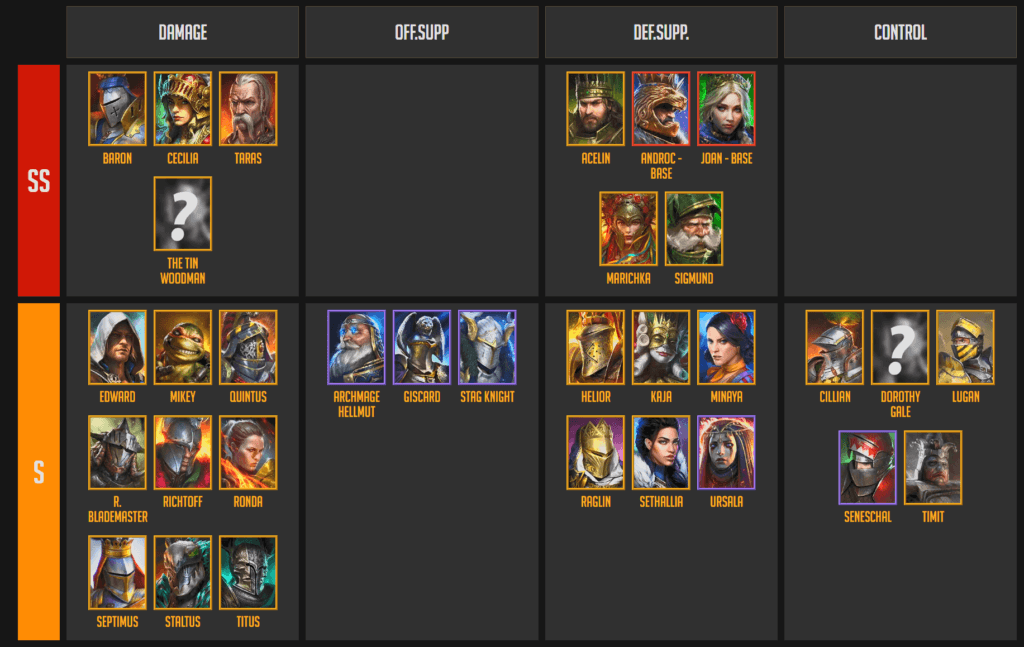
On our Faction Wars Tier Lists we chose to display these roles somewhat differently: instead of buffers and debuffers, we split champions into Offensive Support and Defensive Support.
OFFENSIVE SUPPORT
Offensive Support covers champions with buffs, debuffs, or an effects which help you deal more damage. This could include champions with Decrease DEF debuffs, Shatter buffs, or Ally Attack effects, for example.
DEFENSIVE SUPPORT
Defensive Support covers champions buffs, debuffs, or an effects which help you keep your team alive. This could include champions with Decrease ACC debuffs, Ally Protection buffs, or Remove Debuffs effects, for example.
WHY USE THESE TERMS INSTEAD OF BUFFERS AND DEBUFFERS?
This way of looking at roles is a bit more advanced and is more complicated to explain.
It’s less helpful when it comes to building champions: how do you build an Offensive Support? Some need ACC but some don’t, and so on. Whereas Debuffers all clearly follow a central build concept of needing ACC.
On the other hand, Offensive/Defensive Support categories are more relevant to building teams: you are more likely to be asking, “How do I do more damage?” than, “Do I need more buffs?”. For many fights, Decrease DEF and Shatter are effectively achieving the same goal.
In short, these are two different ways to categorise champions: one leans more towards similar ways to build them; one leans more towards similar ways to use them in a team.
How to Build a Good Team

The Core Team Building Formula
A simple structure for building a good team is 1-2 of each role, though it varies dramatically based on the content you are doing:
In PvP, Control and Damage champions reign supreme. A common team archetype is the speed team, such as: Arbiter; Fabian; Rhaia; Thor. This team will attempt to Fill Turn Meter with Arbiter, Increase Skill Cooldowns with Fabian, Remove Buffs with Rhaia, then deliver lethal damage with Thor.
For Clan Bosses, Hard CC is far less important. Here you will often run lots of offensive and defensive support champions to protect and enable a single hyper-carry damage dealer (or 2 damage dealers, for Hydra). For example, you might run a team of: Mavara; Pelops; Tholin; Uugo; Apothecary. Here Uugo will debuff the boss, while the others protect Tholin, who delivers the damage.
Why There Is No Perfect Team
As you can see, there are often different priorities for team building for every different area of content.
Look for similar types of content, since you can often use the same builds or team ideas across them: Faction Wars waves and Grim Forest waves are very similar; whereas Clan Bosses and Doom Tower bosses are part of an entirely different category.
PvP usually requires specialised champions builds, and you might need 2 different presets for a champion like Mavara if you’re using her in both PvP and PvE.