
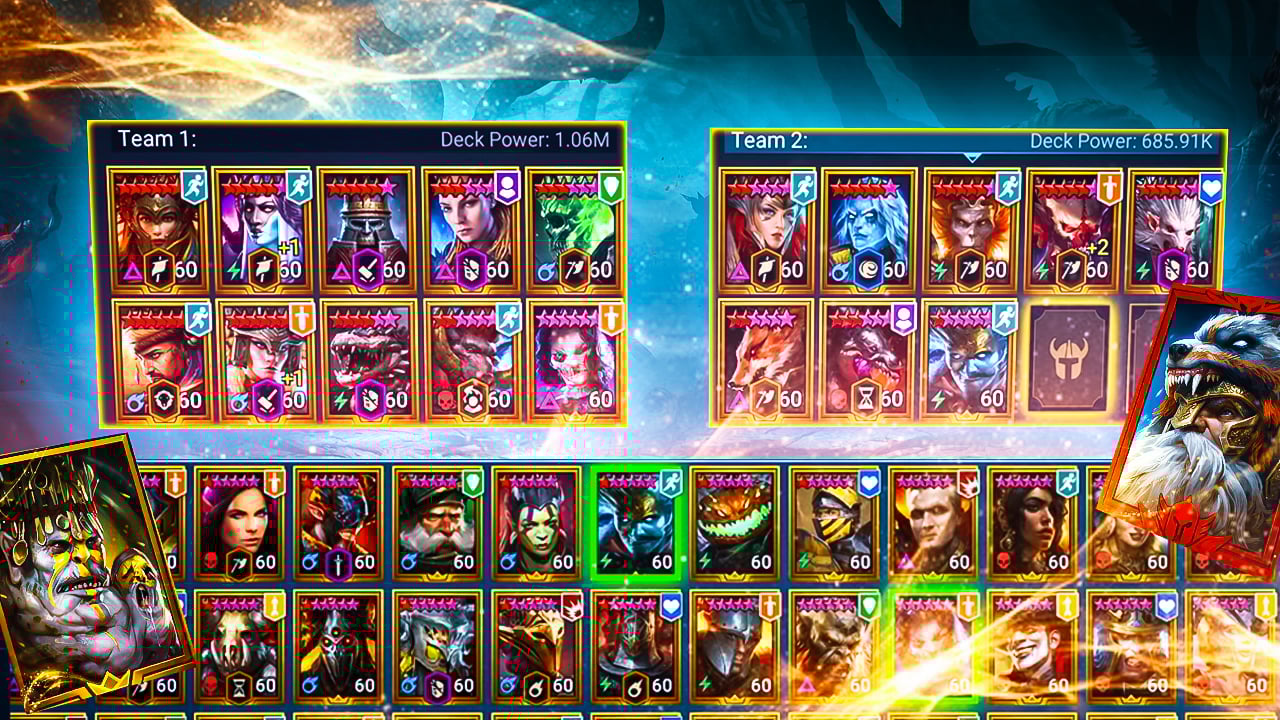

Grim Forest Deck Building Guide
Grim Forest is a very different beast from anything else in Raid. You’re dealing with a huge map, rotating layouts, randomised drafts from your decks, and seven nasty new bosses – including special encounters like the Mimic and Treasure Goblin. Going in blind can feel overwhelming, but once you understand what buffs and debuffs you actually need, Grim Forest becomes much more manageable.
This guide focuses on Hard difficulty, but the principles apply perfectly to Normal as well. Think of it as a “Deck Building 101” for your first rotation and beyond.
How Decks Work

On Normal, you bring two Team Decks of 10 champions each, and on Hard, you bring two Team Decks of 20 champions each. For each stage, the game drafts a set number of champions from each deck depending on the stage’s difficulty and colour.
- Green stages pull 10 champions from each deck.
- Yellow stages pull 8 champions from each deck.
- Red stages pull 5 champions from each deck.
- The secret Purple region pulls a mere 3 champions from each deck.
You may also find a special Aid Altar on the map, which grants you one extra pull per stage. This isn’t a huge deal for the easier stages, but makes a massive difference when you get to the Red or Purple ones.
The important thing: every stage pulls from both decks. You don’t control exactly who shows up, so you need good coverage of key buffs and debuffs spread across both sides.
Balanced Decks vs “One Damage / One Support”
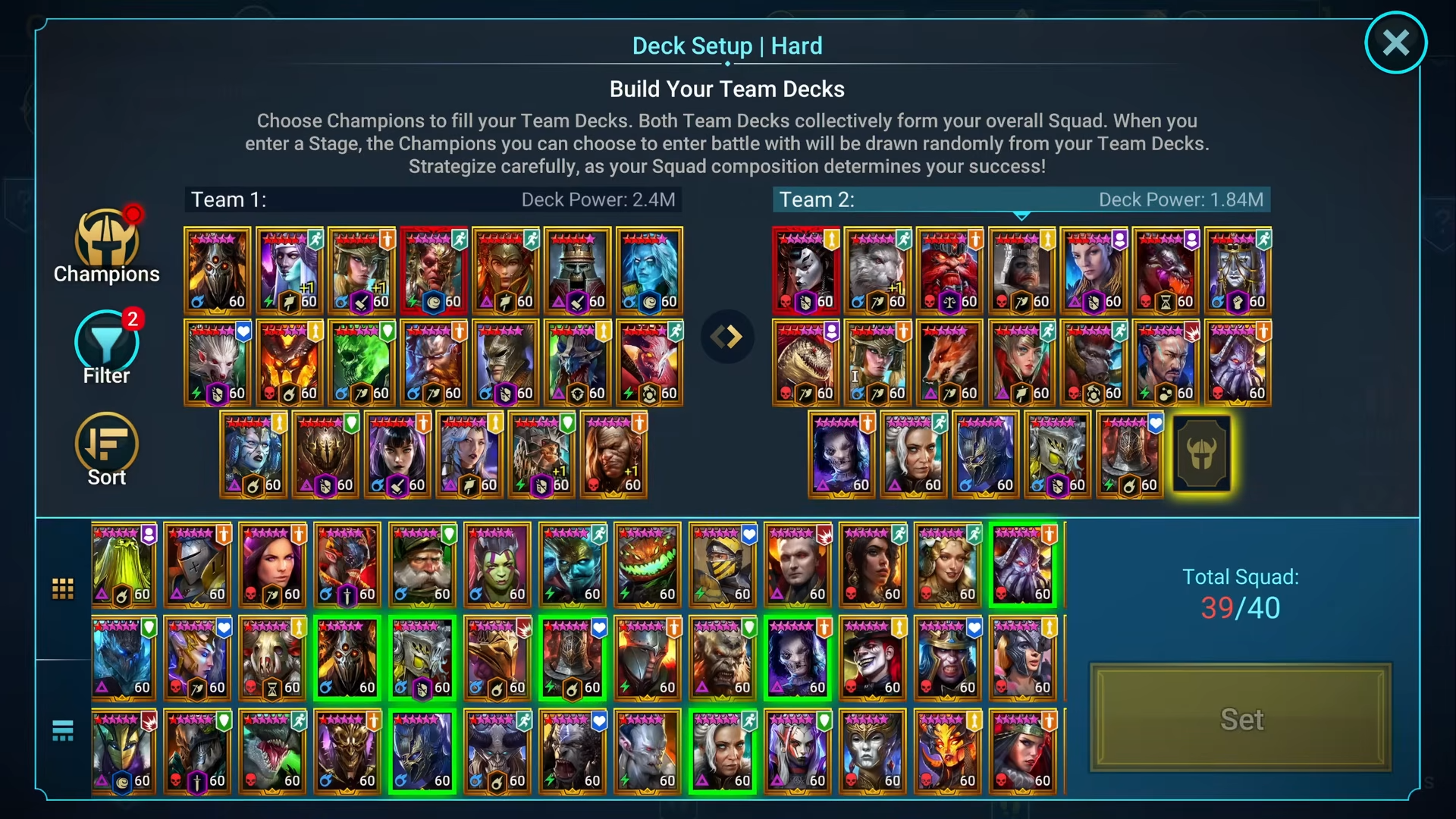
A tempting idea is to put all your damage dealers in one deck and all your supports in the other. In practice, this is risky. If a boss fight really needs multiple key debuffs and all your sources are stuck in one deck with a low draft count, you’ll be forced to redraw or brute-force bad comps.
It’s also very rare for good PvE teams to be 50%+ damage dealers: in a typical team you will have 1 or 2 damage dealers backed up by a variety of buffers, debuffers, and effects.
A more consistent approach is to build two balanced decks:
- Each deck should contain approximately 40% damage dealers and 60% supports.
- Each deck should have access to your essential buffs/debuffs (block debuffs, heal reduction, etc.).
This also makes it easier to split up powerful duos. Instead of stacking pairs like Lady Noelle + Sir Nicholas or Siphi + Rotos in the same deck, putting one in each deck increases your odds of seeing at least one part of a strong combo in any given draft.
Core Buffs You Should Always Bring


Most Grim Forest bosses punish you with brutal debuffs which will destroy an unprepared team. That means defensive utility is king. These are the buffs you want multiple copies of across both decks:
Block Debuffs – This is the single most important buff in Grim Forest. Draugnell spams AoE Freeze and Provoke, Maximoz will overwhelm you with double-damage Poison, Isheth places Master Seal and Block Passive Skills, and Tauraze places Burns which heal him – block debuffs shuts a huge amount of that down. You want several champions who can place it reliably.
Debuff Cleansing/Removal – Even with block debuffs, things will slip through. Maximoz or many mini-bosses can bury you in nasty debuffs if Block Debuffs is gone for even one turn. Cleanse champions add a huge safety layer.
Healing – This may be the game mode where sustain matters most. Phrygius’s gold plates and chip damage from long fights will shred teams if you don’t have strong healing. Think big AoE heals, continuous heals, or sustain passives.
Revive – Because your draft options are limited, losing key champions mid-fight can cost you entire runs. Team revivers or durable single-target revivers let you recover from mistakes and bad RNG.
Increase Speed – Works everywhere. You take more turns, rotate your skills faster, and synergise with the permanent Grim Forest speed bonus your champions gain. Keeping increase speed up almost permanently is ideal.
Other defensive buffs are “nice to have” but not mandatory: shield, block damage, unkillable, and strengthen all shine particularly against Treasure Goblin and the poison boss where incoming burst can be insane.
Advanced options like increase resistance and decrease accuracy can enable high-resist strategies, but these are more niche for initial rotations until you’ve seen more data and tuned your gear.
Essential Debuffs for Grim Forest Bosses


On the offensive side, a few debuffs stand out as close to mandatory for a smooth run:
Heal Reduction – The big one that’s easy to forget and then deeply regret. The Mimic heals 25% of his max HP at the start of his turn, and Isheth stacks huge self-healing via continuous heals. Mini-bosses like Marichka or Riho also lean on heavy healing. Heal reduction turns these encounters from endless slog into manageable fights. Aim for at least one heal reduction champion in each deck.
Block Buffs – Several bosses and elite enemies rely on strong buffs to stay alive or to kill you. Continuous heals, Buff Steals, and mini-bosses become far easier to handle if you are blocking their buffs rather than reacting to them. Champions that combine block buffs with other utility (decrease defence, heals, etc.) are premium.
Buff Removal – Poison Cloud, stolen buffs, ally protection and continuous heals – all of these are much easier to deal with if you can strip them. Having a couple of reliable buff removers in your pool is extremely valuable.
Decrease Speed – Vital for Mimic and the final boss, both of whom can be slowed. Many other bosses are immune, but it still helps a lot on waves. If you can apply decrease speed and heal reduction to the Mimic, he becomes far less scary.
HP Burn – A key debuff for the poison boss and the final boss, and generally strong in long fights. A couple of burn champions across your decks will carry a lot of weight, especially if they also bring other utility.
Decrease Defence – Still very useful for racing down bosses like the Mimic and speeding up fights in general, but slightly lower priority than survival/utility debuffs in this mode.
Turn meter control (increase/steal/reduce) is great for waves and especially good versus Mimic and the final boss, both of whom are partially vulnerable to it. Most other bosses are immune to turn meter and control effects, so treat it as strong but not essential.
Finally, Freeze deserves a special mention: Tauraze gains turn meter every time he’s hit by someone without HP burn – and multi-hit skills can rocket his bar up. A good freeze champion can help manage his turn meter, while also controlling waves on other stages. Ideally, have at least one reliable freeze user in each deck if your account allows it.
Champion Roles and Practical Deck Building
When you start assigning actual champions, think less in terms of “raw damage” and more in terms of roles:
- Core defensive supports who bring two or more of: block debuffs, cleanse, heals, revive, increase speed.
- Specialist debuffers with heal reduction, block buffs, HP burn, decrease speed or buff removal.
- Wave control and nukers for clearing the map efficiently (stuns, freezes, AoE nukes, increase cooldowns).
- Boss specialists who line up well with key fights (e.g. strong burn against poison boss, heal reduction for Mimic, freeze for fire boss).
A good baseline for most fights is three supports and two damage dealers. Some Mimic stages and easier waves can run three damage dealers, but leaning towards more supports makes Hard much less punishing overall.
Where you have strong duos or mythicals, don’t forget the drafting logic. You’ll often get better consistency by splitting powerful pairs and spreading your best utility across both decks rather than stacking everything into a “god deck” that you might not draw from on a crucial stage.
Common Pitfalls to Avoid
A few things that will cause major headaches if you miss them:
- No or very little heal reduction, making Mimic fights nearly unwinnable in a reasonable time.
- Too few healers and revivers, making deaths easy and run-ending.
- Bringing too many damage-dealers without focusing on key buffs/debuffs needed for the tough encounters.
- Ignoring block debuffs and cleanse, leading to endless freezes, fears, poisons and turn meter control from bosses.
If you fix those issues and follow the priorities above, your first Grim Forest rotation – even on Hard – will feel far more controlled and less like banging your head against a wall.
Final Thoughts
Grim Forest is designed to test your roster depth and your understanding of mechanics more than your raw stats. Building balanced decks with overlapping coverage of the key buffs and debuffs is the best way to future-proof yourself against different rotations and boss placements.
Stack up on block debuffs, cleanse, healing, revive and speed manipulation; bring heal reduction, block buffs, HP burn and decrease speed for your core debuffs; then fill in the gaps with wave control and damage. Do that, and even the Mimic, Maximoz and Phrygius will start to look like puzzles to be solved rather than brick walls.
I think splitting the decks into “Each deck should contain approximately 40% damage dealers and 60% supports” is very risky. We have two players in our clan who did it that way. Both of them ended up without any damage dealers at one point. That can’t happen with my preferred split of one deck of damage dealers and one deck of support. I think in the end everyone has to decide which variant carries the least risk for them.